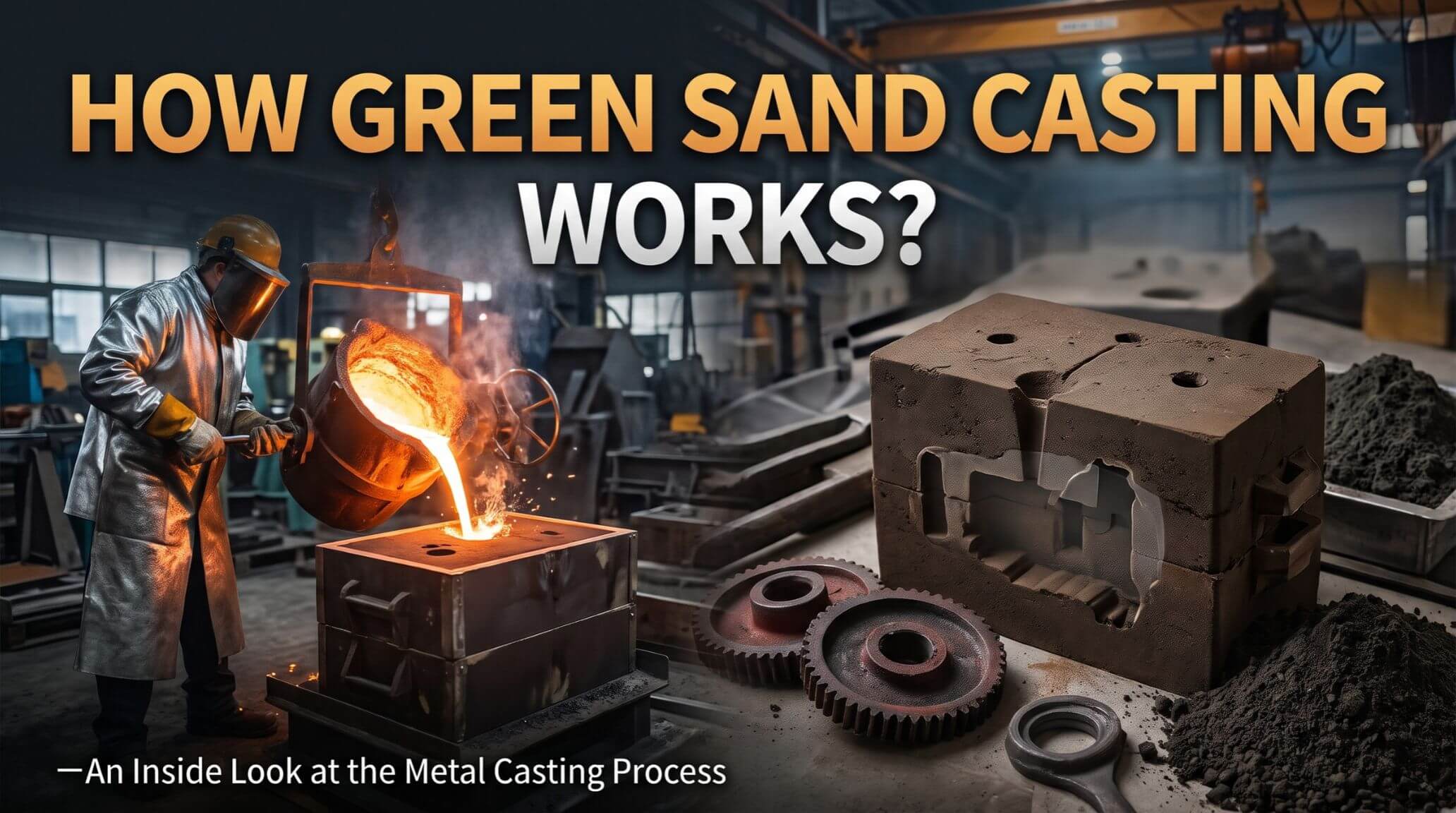
Green sand casting is one of the most widely used ways to make iron castings in volume: molten metal is poured into a mold made of sand bonded with clay and water. "Green" means the mold is still moist when the metal goes in — it is never baked or chemically cured.
It is fast and low-cost, and the sand is reused again and again. The trade-off is a rougher surface and looser tolerances than processes such as investment casting.
Why It's Called Green Sand Casting, and What's in the Mix
Green sand is a mix of sand, clay and water that holds its shape when packed around a pattern. A typical mix looks like this:
| Ingredient | Typical share | What it does |
|---|---|---|
| Silica sand | The balance (most of the mix) | Forms the mold and withstands molten metal |
| Bentonite clay | About 7–8% active clay | Binds the grains so the mold keeps its shape |
| Water | About 3–4% | Activates the clay's bonding power |
| Additives (e.g. seacoal) | Small amounts | Improve surface finish and shakeout |
Because the bond comes from clay and water rather than chemical resin, used sand can be screened, cooled, re-mixed with fresh clay and water, and molded again.
Sources: clay and water ranges from US Patent 6,591,891 and US Patent 4,203,771 (green sand for high-pressure molding).
The Green Sand Casting Process in 8 Steps
A production green sand line repeats the same eight steps for every mold:
| Step | What happens | Why it matters |
|---|---|---|
| 1. Pattern | A metal or resin pattern of the part, plus gates and risers, is mounted on a pattern plate | Pattern accuracy sets the casting's dimensions |
| 2. Sand preparation | Returned sand is cooled, screened and mixed (mulled) with clay and water | Consistent sand = consistent molds |
| 3. Molding | Sand is compacted around the pattern in two halves: the cope (top) and drag (bottom) | Even compaction prevents swelling and erosion |
| 4. Core setting | Sand cores are placed in the drag to form internal passages | Creates bores and cavities the mold alone cannot |
| 5. Closing | The cope is lowered onto the drag and the mold is clamped or weighted | Stops mismatch and metal leaks |
| 6. Pouring | Molten iron fills the cavity through the gating system | Controlled flow avoids sand inclusions |
| 7. Cooling and shakeout | The casting solidifies; the mold is broken apart on a shakeout | Sand returns to step 2 for reuse |
| 8. Cleaning and inspection | Gates and risers are removed, castings are shot-blasted, ground and inspected | Final dimensions, surface and properties checked |
The same sequence applies to both gray and ductile iron; ductile iron adds a magnesium treatment step before pouring.
Green Sand or No-Bake? Let Part Size and Volume Decide
No-bake (chemically bonded) sand is the other main sand process. The choice usually comes down to part size and volume:
| Factor | Green sand | No-bake sand |
|---|---|---|
| Binder | Clay + water | Chemical resin + catalyst |
| Mold cycle | Fast; suited to automatic lines | Slower; molds must cure before pouring |
| Best volume | Medium to high | Low to medium, prototypes |
| Best part size | Small to medium | Medium to very large |
| Mold rigidity | Lower | Higher; holds detail on big parts |
| Sand reuse | High; re-bonded with clay and water | Needs thermal or mechanical reclamation |
| Cost per part | Lower at volume | Higher |
In short: green sand for repeat production of small-to-medium iron parts; no-bake for large, heavy or one-off castings.
What Green Sand Casting Does Well, and Where It Struggles
| Advantages | Limitations |
|---|---|
| Low tooling and per-part cost | Rougher surface than investment or die casting |
| Fast mold cycle, ideal for automation | Looser dimensional tolerances; machining allowance needed |
| Sand reused after every pour | Moisture can cause gas defects if sand control slips |
| Works for gray, ductile and many other alloys | Less suited to very large or very thin-walled parts |
| Wide range of part shapes, cored internal passages | Pattern changes take time; best for repeat orders |
Most limitations come down to sand control. Foundries that test sand moisture, compactability and strength throughout each shift keep defects low and dimensions repeatable.
Which Iron Parts Are Made in Green Sand?
Green sand fits iron parts that are ordered repeatedly and machined afterwards:
| Industry | Typical green sand castings |
|---|---|
| Automotive and motorcycle | Brackets, hubs, brake parts, housings (see examples) |
| Power transmission | Gearbox housings, carriers, couplings |
| Machinery | Pump and valve bodies, machine components |
| Construction and infrastructure | Fittings, frames, architectural castings |
Why Automatic Molding Lines Make Better Green Sand Castings
On an automatic line, every mold is compacted with the same pressure and every sand batch is mixed to the same recipe. The result is fewer mold-to-mold differences, steadier dimensions and faster delivery than hand molding.
TA Talent runs automatic green sand molding with in-house sand processing and recycling, so returned sand is cooled, re-bonded and tested before it is molded again (see our capabilities).
Planning a new iron part? Send us your drawing and we will confirm whether green sand is the right process and quote the tooling and unit cost.
Green Sand Casting Questions Buyers Ask
What is green sand for casting?
A molding mix of sand, bentonite clay and water. It is called "green" because the mold is used moist, not because of its color.
Is green sand casting the same as sand casting?
It is one type of sand casting, and the one built for fast, repeat production. Other types bond the sand with chemical resins (no-bake) or bake the mold before pouring.
Can green sand be reused?
Yes. After shakeout, the sand is cooled, screened and re-mixed with fresh clay and water, then molded again.
What metals can be cast in green sand?
Gray iron, ductile iron and many non-ferrous alloys, such as aluminum and bronze, are commonly cast in green sand.
Is green sand casting cheaper than investment casting?
Usually, for small-to-medium iron parts in volume. Investment casting costs more but gives a finer surface and tighter tolerances.