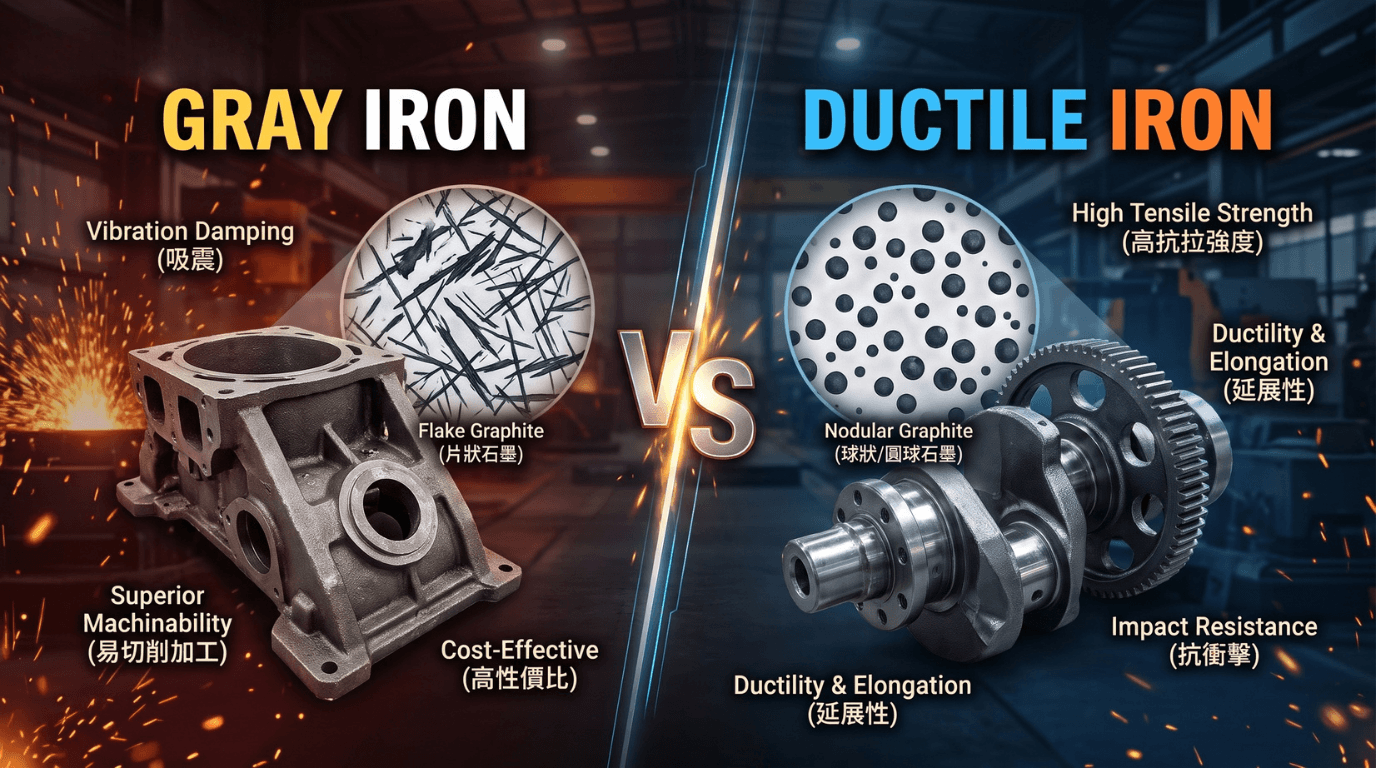
Choose gray iron for damping, easy machining and low cost under compressive loads. Choose ductile iron when a part must survive tension, bending or impact.
The standards show the gap: ASTM A48 gray iron tops out at 60 ksi (414 MPa) with no elongation requirement, while ASTM A536 ductile iron starts at 60 ksi and guarantees up to 18% elongation. Pick wrong, and you either risk a cracked part or pay for strength you never use.
What Is the Difference Between Gray Iron and Ductile Iron?
Both irons start from a similar melt of iron, carbon and silicon. The difference is the shape the carbon takes as the casting solidifies:
| Gray iron | Ductile iron | |
|---|---|---|
| Graphite | Thin, connected flakes | Round nodules |
| How it forms | Untreated melt | Magnesium treatment + inoculation before pouring |
| What it means | Flake tips act as notches, so cracks run easily | No sharp edges, so the metal stretches before it breaks |
| Other names | Grey iron, flake graphite iron | Nodular iron, spheroidal graphite (SG) iron |
Gray Iron vs Ductile Iron Properties: Comparison Chart
Ductile iron wins on strength and toughness; gray iron wins on damping, machining and cost.
| Factor | Gray iron | Ductile iron |
|---|---|---|
| Standard (US) | ASTM A48 | ASTM A536 |
| Tensile strength, min | 138–414 MPa | 414–689 MPa (common grades) |
| Elongation | Not specified | 3–18% |
| Impact / bending | Brittle | Bends before it breaks |
| Vibration damping | Excellent | Good |
| Machinability | Very good | Good |
| Heat transfer | Higher | Lower |
| Cost | Lower | Higher |
Sources: ASTM A48/A48M; ASTM A536 (summary via Portland Bolt).
Gray and Ductile Iron Grades: ASTM vs EN vs JIS Equivalents
In ASTM A48, the gray iron class number is its minimum tensile strength in ksi; no ductility is required.
| ASTM A48 | Tensile, min | EN 1561 | JIS G5501 |
|---|---|---|---|
| Class 20 | 138 MPa | EN-GJL-100 | FC100 |
| Class 25 | 172 MPa | EN-GJL-150 | FC150 |
| Class 30 | 207 MPa | EN-GJL-200 | FC200 |
| Class 35 | 241 MPa | EN-GJL-250 | FC250 |
| Class 40 / 45 | 276–310 MPa | EN-GJL-300 | FC300 |
| Class 50 | 345 MPa | EN-GJL-350 | FC350 |
ASTM A536 ductile grades name three minimums: tensile, yield and elongation (65-45-12 = 65 ksi, 45 ksi, 12%).
| ASTM A536 | Tensile, min | Yield, min | Elongation, min |
|---|---|---|---|
| 60-40-18 | 414 MPa | 276 MPa | 18% |
| 65-45-12 | 448 MPa | 310 MPa | 12% |
| 80-55-06 | 552 MPa | 379 MPa | 6% |
| 100-70-03 | 689 MPa | 483 MPa | 3% |
EN and JIS ductile names read the same way in metric: EN-GJS-450-10 and JIS FCD450-10 both mean 450 MPa and 10% elongation, close to ASTM 65-45-12. Treat cross-references as a guide only — test methods differ, so put one standard on the drawing. Need more strength? See ADI in our casting vs forging guide.
Sources: ASTM A48, A536; EN 1561, 1563; JIS G5501, G5502; gray iron equivalents per Goldens' Guide to Ductile Iron Grades.
When to Use Gray Iron vs Ductile Iron: Applications by Part
The rule of thumb: stiff, heavy and stationary points to gray iron; loaded, moving or safety-critical points to ductile iron.
| Part type | Better choice | Why |
|---|---|---|
| Machine tool bases, beds, columns | Gray | Best vibration damping; loads are compressive |
| Brake discs and drums | Gray | Spreads heat, resists thermal cracking |
| Heavily machined covers, pump bodies | Gray | Chips break cleanly; faster cycles |
| Shafts, hubs, yokes, carriers | Ductile | Handles cyclic torque and shock (power transmission castings) |
| Valve bodies, fittings, hydraulics | Ductile | Survives pressure spikes |
| Suspension and structural brackets | Ductile | Absorbs road and field impacts |
| Former steel weldments or forgings | Ductile / ADI | Near-net shape at lower cost |
| Weight-sensitive designs | Ductile | Higher strength allows thinner walls |
Ductile Iron vs Gray Iron for Gearbox and Reducer Housings
For housings, where the unit is mounted matters more than gear load:
| Gray iron | Ductile iron | |
|---|---|---|
| Mounting | Fixed, rigid base | Vehicles, mobile machines, robot arms |
| Main concern | Quiet running, low cost | Crack resistance, lower weight |
| Examples | Stationary reducers, pump housings | Ag and mobile gearboxes, robot joint housings |
Watch the mounting feet, flange ears and bolt bosses — that is where gray iron housings usually crack.
How to Choose Between Gray and Ductile Iron: Quick Checklist
Any "yes" below points to ductile iron:
- Will the part see impact, shock or a dropped load?
- Does it carry tension, bending, torque or pressure?
- Would a sudden fracture injure someone or stop a line?
All "no", and damping, machining or cost matter most? Gray iron is likely the better buy.
Not sure? Send us your drawing and load case — TA Talent has cast iron parts in Taiwan since 1986 and will recommend the lowest-cost grade that does the job.
Gray Iron vs Ductile Iron: FAQ
-
Is ductile iron stronger than gray iron?
Yes. The weakest common ductile grade (60-40-18, 414 MPa) matches the strongest gray iron class, and it adds guaranteed elongation.
-
Is ductile iron the same as cast iron?
It is one type of cast iron. "Cast iron" on its own usually means gray iron.
-
What is FCD450?
A JIS G5502 ductile iron grade: 450 MPa minimum tensile strength (FCD450-10 adds 10% elongation), close to ASTM 65-45-12.
-
What is the difference between CI and SG iron?
CI usually means gray (flake graphite) iron; SG (spheroidal graphite) iron is ductile iron.
-
Is grey iron cheaper than ductile iron?
Gray iron, per part. Ductile can still cost less overall if thinner walls or a replaced steel weldment cut weight and machining.