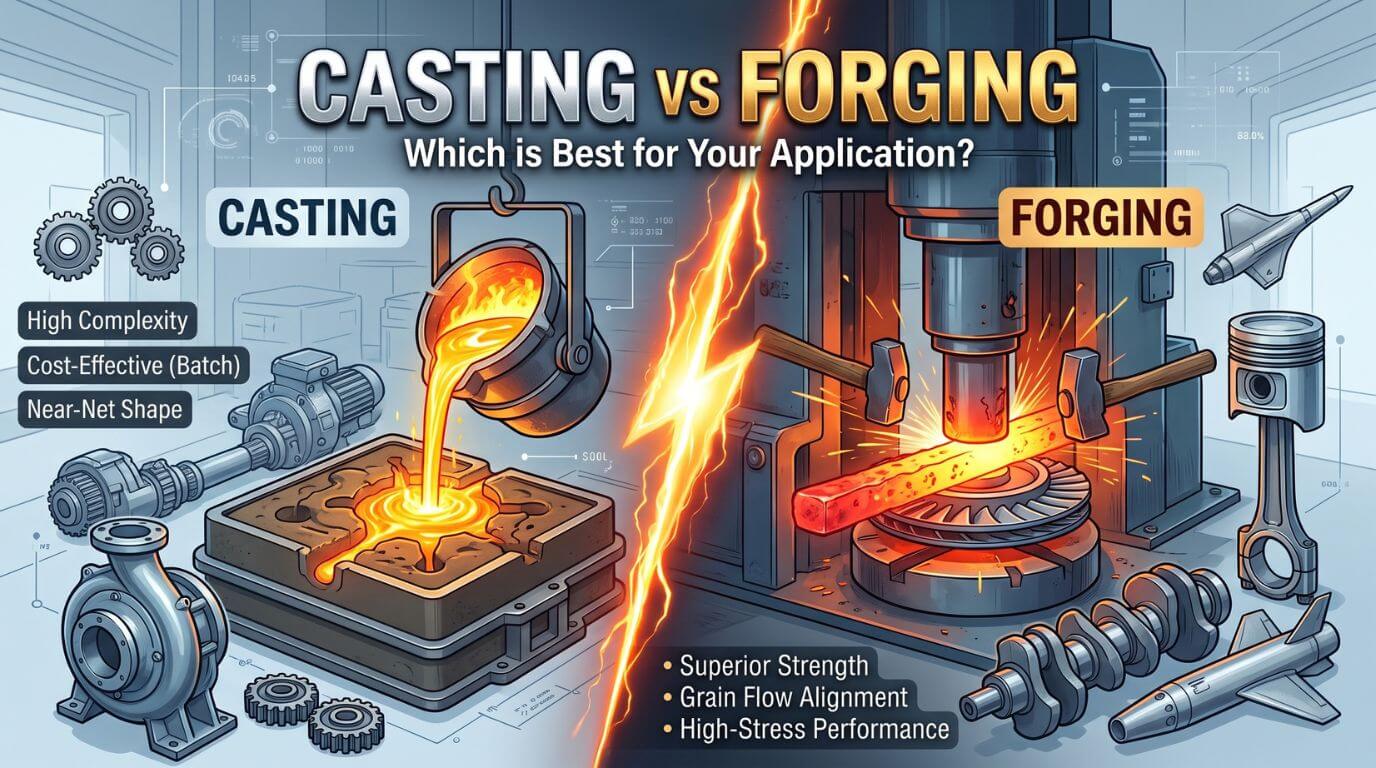
A component forged in steel a decade ago may now be a strong candidate for ductile iron or austempered ductile iron (ADI) casting — and getting the call wrong in either direction shows up as extra machining hours, heavier assemblies or early fatigue failures. Below, we compare the two processes side by side and explain where ductile iron closes the gap.
Casting vs Forging at a Glance
The core difference is the state of the metal: casting shapes metal as a liquid, while forging shapes it as a solid under pressure. Nearly every other difference between the two processes follows from that one fact, as the comparison below shows:
| Factor | Casting | Forging |
|---|---|---|
| Metal state during forming | Molten, poured into a mold | Solid, shaped by hammer or press (hot, warm or cold) |
| Internal grain structure | Non-directional, set during solidification | Directional grain flow that follows the part contour |
| Geometry | Complex shapes; internal cavities and passages formed by sand cores | Simpler external shapes; no internal cavities |
| Part size | Small to very large, especially in sand casting | Limited by press or hammer capacity and die size |
| Tooling | Patterns and core boxes; lower upfront cost in sand casting | Hardened steel dies; higher upfront cost |
| Material options | Wide range, including gray, ductile and compacted graphite irons | Forgeable alloys such as steel, aluminum, titanium and copper alloys |
| Machining allowance | Near-net shape; less stock to remove | Often more machining to reach final geometry |
| Typical strengths | Design freedom, vibration damping in graphite irons, cost on complex parts | Impact toughness and fatigue resistance in compact parts |
One row deserves emphasis. Gray iron, ductile iron and compacted graphite iron (CGI) cannot be forged, so specifying any of them also means specifying casting.
How Each Process Works
Casting starts with a cavity; forging starts with a solid billet. In sand casting — the method TA Talent uses for ductile and gray iron — production runs through the following stages:
- Pattern and mold making. A pattern of the part is packed in sand to form the mold cavity, and sand cores are set wherever the part needs internal passages.
- Melting and treatment. Iron is melted and its chemistry adjusted. For ductile iron, magnesium treatment (nodularizing) and inoculation convert the graphite into spherical nodules.
- Pouring and cooling. Molten iron fills the mold and solidifies into the part shape.
- Shakeout and finishing. The sand is broken away, and the casting is cleaned, heat treated if required, machined and inspected.
Forging takes a different route. A heated billet — or a cold one, in cold forging — is compressed between dies. Open-die forging shapes the metal with flat or simple tools and suits large, simple parts; closed-die forging presses it into a cavity that defines the final shape more closely.
Those different routes explain why the two processes produce different internal structures — and why the strength question is more nuanced than it first appears.
Is Forging Always Stronger?
Not automatically. Forging improves the properties of a given alloy, but the strength of a finished part depends just as much on which alloy you start with.
The difference comes down to microstructure and how each process achieves internal soundness, as the comparison below shows:
| Factor | Forged steel | Ductile iron / ADI casting |
|---|---|---|
| Grain structure | Refined and aligned with the part contour | Non-directional, set during solidification |
| Internal soundness | Voids closed by deformation | Shrinkage and porosity controlled by gating design, solidification control and inspection |
| Source of ductility | Steel matrix plus grain flow | Spherical graphite nodules that interrupt the matrix far less than flake graphite |
| Strength range | Depends on steel grade and heat treatment | 414–689 MPa min (ASTM A536); 750–1,200 MPa min (ASTM A897M grades below) |
| Best fit | Compact parts under repeated shock loading | Complex, load-bearing parts where geometry drives cost |
Against cast steel of a similar grade, forged steel generally comes out ahead because of its grain flow. In practice, though, engineers usually weigh forged steel against a cast iron with its own microstructure. The useful question is which process and material combination meets the load case at the lowest total cost.
Where Casting Wins
Casting wins when a part's geometry, size or damping requirement would push a forging into extra machining, welding or assembly. Four situations come up repeatedly in the parts our customers send us:
- Internal passages and cavities. Sand cores form oil galleries, coolant channels and hollow sections in a single pour. A forging cannot produce internal cavities, so those features must be drilled, machined or fabricated afterward. (See our In-House Core Making capability.)
- Large or irregular parts. Sand casting is not bound by press tonnage or die size, which makes it the practical route for machine bases, frames and large housings.
- Near-net shape. A casting leaves the mold close to its finished geometry, so less material is removed and fewer machining operations are needed.
- Vibration damping and weight. The graphite in gray and ductile iron absorbs vibration, which is why these irons are specified for machine tool bases and robot structures. Ductile iron is also less dense than steel, so a cast iron part weighs less than a steel part of the same volume.
For many of these parts, the remaining objection to casting is strength. That is where ductile iron and ADI come in.
The Middle Ground: Ductile Iron and ADI as Forging Alternatives
Ductile iron and ADI give engineers a third option: casting's design freedom combined with mechanical properties high enough for structural, load-bearing components.
Standard ductile iron is specified to ASTM A536. The grade name states the minimum tensile strength, yield strength and elongation in imperial units, as the most commonly used grades show:
| ASTM A536 grade | Tensile strength, min (MPa) | Yield strength, min (MPa) | Elongation, min (%) |
|---|---|---|---|
| 60-40-18 | 414 | 276 | 18 |
| 65-45-12 | 448 | 310 | 12 |
| 80-55-06 | 552 | 379 | 6 |
| 100-70-03 | 689 | 483 | 3 |
ADI takes the same material further. Ductile iron castings are austenitized, then quenched into a salt bath and held at a controlled temperature (austempering). The result is an ausferrite matrix that roughly doubles strength compared with conventional grades while keeping useful ductility. ASTM A897/A897M covers ADI in metric grades such as:
| ASTM A897M grade | Tensile strength, min (MPa) | Yield strength, min (MPa) | Elongation, min (%) |
|---|---|---|---|
| 750-500-11 | 750 | 500 | 11 |
| 900-650-09 | 900 | 650 | 9 |
| 1050-750-07 | 1,050 | 750 | 7 |
| 1200-850-04 | 1,200 | 850 | 4 |
Sources: ASTM A536, Standard Specification for Ductile Iron Castings; ASTM A897/A897M, Standard Specification for Austempered Ductile Iron Castings.
These properties are why ductile iron and ADI are replacing forged and fabricated steel in robot bases and joint housings, RV reducer and harmonic reducer housings, gearbox housings and structural arms in automation equipment. (See Castings for Industrial Robotics.) For small, safety-critical parts under repeated shock loading, forged steel remains the conservative choice.
Material properties settle whether a cast part can do the job. Cost and lead time usually decide whether it should.
Cost and Lead Time
Casting usually costs less upfront, and the gap widens as part complexity rises. Forging becomes more competitive on simple shapes at high volume, where the cost of hardened dies spreads across many parts.
Three cost drivers make the difference, with lead time as the fourth factor to check:
| Cost driver | Sand casting | Closed-die forging |
|---|---|---|
| Tooling | Patterns and core boxes; lower cost to make and modify | Hardened steel dies; higher cost and slower to change |
| Machining | Near-net shape; less stock to remove | More material removed to reach final geometry |
| Secondary operations | One casting can replace welded or bolted assemblies | Brackets and sub-assemblies often welded or bolted on |
| Best volume range | Prototypes through high volume, especially complex parts | High volume of simple shapes, where die cost spreads out |
FAQ
Is casting cheaper than forging?
For complex or large parts, usually yes, because tooling and machining costs are lower. For simple shapes made in very high volume, forging can match or beat casting on unit cost.
Can a forged part be converted to a casting?
Often, yes. The part is reviewed against its load case, then redesigned for casting — typically in ductile iron or ADI — and validated with test castings before production.
Cast iron vs forged steel: which is stronger?
Forged steel is tougher under impact. High-strength ductile iron and ADI, however, reach strength levels suitable for many structural parts previously made from forged steel, at lower weight and cost.
What is ADI?
ADI (austempered ductile iron) is ductile iron that has gone through an austempering heat treatment. It offers about twice the strength of conventional ductile iron while remaining castable into complex shapes.